
Thesis
2. Narrowing Your Topic and Formulating Research Questions
- Turning a Good Topic into a Feasible Research Project
Foreword (click here!)
Thesis
Credit value: 10
The aim of the Thesis Seminar is to enable students to demonstrate, within their chosen professional field, their ability to synthesize practical professional experience and theoretical knowledge. Through research on the selected topic and the preparation of the thesis, students are expected to further their development as performing artists by establishing a reflective relationship with their own professional experiences.
Theoretical knowledge to be acquired
Familiarity with fundamental research methodologies and ethical principles relevant to the field of movement-based performing arts. Understanding of the concept of plagiarism. Knowledge of the requirements and conventions of academic writing. Basic knowledge of argumentation techniques. Fundamental understanding of the dramaturgical and rhetorical structure of written and oral presentations.
Practical knowledge to be acquired
The ability to articulate practical experiences and communicate them effectively to a professional community, using professional terminology in a conscious and appropriate manner. Application of methods for source research and source utilization. Proficient use of text formatting and editing techniques. Clear distinction between one’s own ideas and those of others through the conscious use of rhetorical and grammatical devices. Understanding and application of citation and referencing principles according to specified academic standards. Application of the dramaturgical and rhetorical characteristics of oral and written presentations. Active participation in professional discourse and proficient use of fundamental argumentation techniques. Conscious application of ethical and professional considerations during discussions, feedback sessions, questioning, and responding to questions.
1. Description of the Challenge
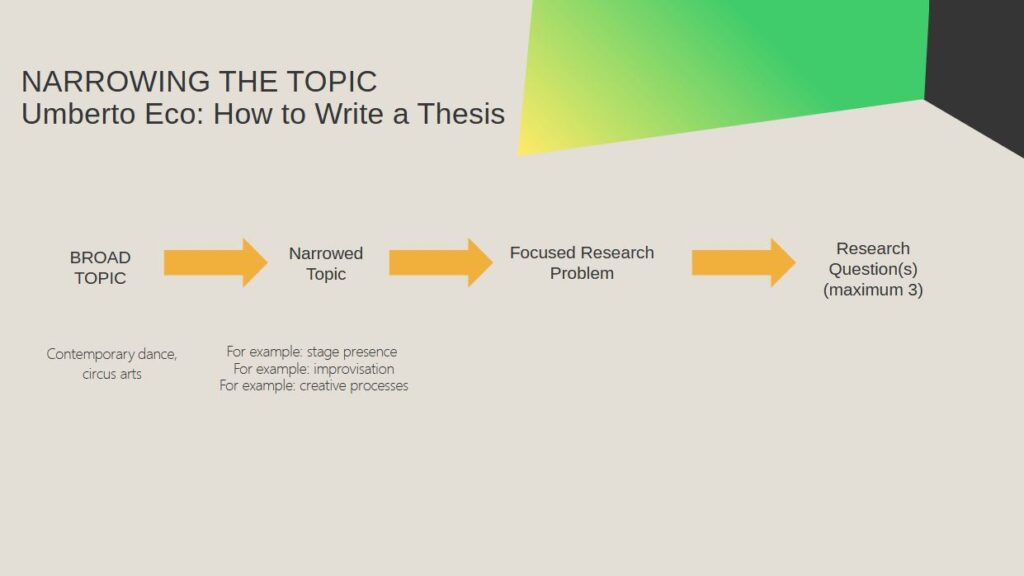
Choose the topic idea that you identified as the strongest in the previous lesson, and narrow it down until it becomes realistically researchable within one semester.
Continue working with the topic you selected in the previous lesson if your instructor has approved it. Always proceed with the topic recommended or approved by your instructor.
This time, feel free to work directly in a Word document.
2. Basic Information for Completing the Task
- An overly broad topic does not provide a clear direction for research. Narrow your topic by focusing on one or more of the following:
- time period – do not try to research the past 100–200 years;
- location – for example, Budapest or the Capital Circus of Budapest, rather than the whole of Europe;
- artist / creator – it is enough to examine one artist in depth, or at most 2–3 artists if you are planning a comparison;
- company / ensemble – similarly, you may analyse several productions by one company, or compare one production each from a maximum of 2–3 companies. The entire history of the Eötvös Circus, for example, would be far too broad;
- work – see the principle above for artists/creators;
- performance or type of performance – see the principle above;
- target group – for example, children’s productions at the Vígszínház. Since the Vígszínház does not primarily produce performances for children, this already represents a meaningful narrowing of the topic;
- technique; or
- a specific phenomenon.
- List what genuinely interests you about this topic. What is the specific problem, issue, or phenomenon that you would like to explore further? This will become your research problem.
- What questions would you like to answer in relation to your topic? Write down three.
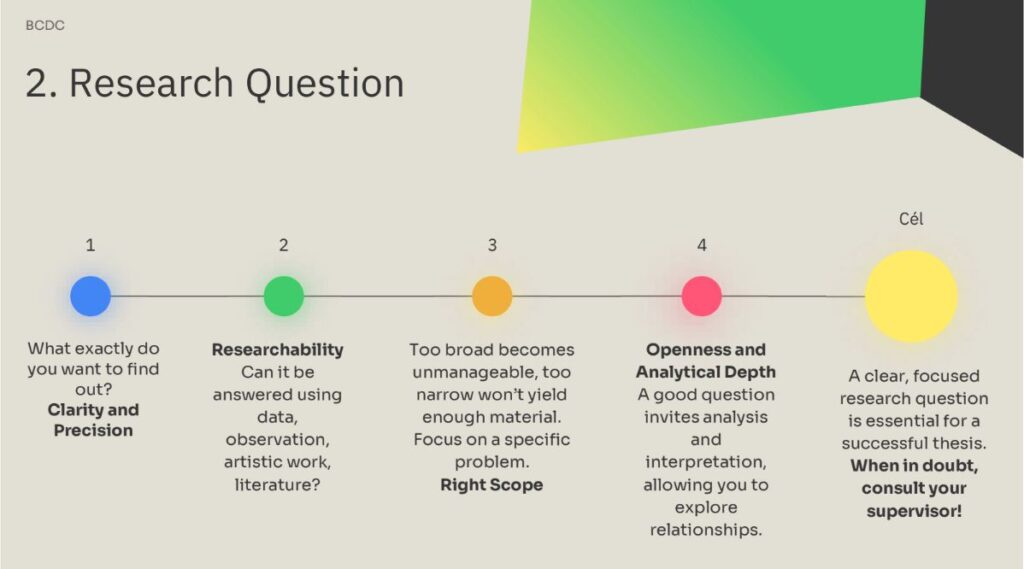
- It is important to choose questions to which you genuinely do not yet know the answer. Avoid questions with obvious answers, because such questions do not provide much scope for research. These will become your research questions.
- Write three possible working titles for your topic. Make sure that each title highlights a slightly different aspect of the problem. Each title should include the subject of the research and, if possible, the perspective or aspect from which you plan to examine it.
- Write at least 2,000 characters about your topic. This will already function as a short abstract—that is, a concise introductory text presenting your research topic.
- In this text, summarise the steps you have completed so far:
- What is your working title and narrowed topic?
- What is your personal connection to this topic? (See the previous task.)
- What is your personal connection to this topic? (See the previous task.)
- Approximately how do you plan to approach and investigate the topic? (See the previous task.)
If you are unsure how to structure this text, have a look at last year’s Workshop Conference Abstract Book on the College website.
Checkpoint
Self-check question: Is my topic narrow enough to investigate properly within the time available? Do I have enough time, sources, access, and research material to complete the project?
Your thesis will ultimately come together over approximately half a year, at least in terms of the main research and writing process. During this period, you will need to investigate your chosen topic, produce meaningful results, and answer your research questions.
Read through the abstract you have just written together with the self-check question above, and reconsider your topic once more. For example, you may have enough time because you have narrowed your topic carefully, but if all the relevant source material is located on the other side of the world and you will have no access to it, the topic may still not be feasible. Similarly, if you currently live abroad and would like to research Hungarian folk dance, this may not be practical if you have no access to the relevant communities or materials. However, if you examine Hungarian folk dance within diaspora communities, or study folk dance activities organised by other national or ethnic communities that are accessible to you, you may once again be on the right track.
3. Method of Completion
Save the document as: NAME_Topic_Narrowing_Abstract.docx
and upload it to your “Thesis_Your Name” folder.
Recommended literature
